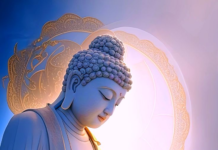
The modern world is breathless with the effort of self-promotion. We are told that “personal branding” is the ultimate currency, and that to be overlooked is to be obsolete. Yet, beneath the polished veneers of LinkedIn profiles and social media influence lies a growing exhaustion—a sense that the more we assert our superiority, the more fragile our success becomes. The Maharatnakuta Sutra (Kinh Đại Bảo Tích) offers a startling resolution to this fatigue: our desperate drive to be seen as “Number One” is the precise mechanism of our sabotage. In the physics of the spirit, true height is achieved only by those who master the art of the descent.
Arrogance: The Ultimate Contraction of Spiritual Equity
Arrogance (khinh mạn) is rarely understood for what it truly is: a force of “equity contraction.” When we view ourselves as superior to others, we are not merely committing a moral error; we are effectively capping our own capacity to grow.
Consider the historical inversion of Devadatta and Shakyamuni Buddha. According to the source, Devadatta was originally the teacher—a master who held the profound Lotus Sutra in his hands. Shakyamuni was his humble student, performing menial tasks and making his teacher’s bed. However, because Devadatta viewed his position with pride, his spiritual assets began to “shrink.” Conversely, because Shakyamuni maintained a state of total reverence and lacked all arrogance, he was able to “copy” the merit and wisdom of the teacher. He attained enlightenment rapidly, while the teacher, consumed by the weight of his own ego, eventually fell.
Analysis: Arrogance creates a cognitive and spiritual blockage. When you believe you are “above” the room, you exit the “student state.” You become a “full cup”—an isolated system unable to receive new wisdom, feedback, or the natural flow of universal blessings.
The “Servant’s Heart” Strategy for High Performance
The Maharatnakuta Sutra outlines a radical vow: the practitioner must view themselves as a “dog” or a “servant” (Chiên-đà-la). In a leadership context, this is not a call for low self-esteem, but a strategy for removing “ego-friction.”
High-level officials and visionary entrepreneurs like Elon Musk often succeed through what the Master calls the tướng nô tài (the servant’s heart). This is the ability to attend to the most minute details of a mission with the obsessive loyalty of a servant. Success in the marketplace or in governance requires an absolute submission to the needs of the customer or the citizen. Those who cannot lower themselves to this level of service are never the masters; they remain “hired help,” forever limited by their refusal to serve the small things.
“The lower you can humble yourself, the higher your position and blessings will eventually be.”
Strategic Distancing : Humility, however, is not a lack of discernment. A true leader understands when to apply Mặc tẫn—the practice of silently distancing oneself from those who refuse to be in a “student state.” If a environment is toxic or an individual is unwilling to learn, the humble leader does not engage in conflict; they simply move away, preserving their energy for those who can truly receive it.
The Worst Trade-Off: Converting Gems into Fertilizer
In the economy of karma, the habit of Tự tán hủy tha—praising oneself while belittling others—is a catastrophic financial mistake. The source describes this as selling precious gems to buy someone else’s trash.
This “spiritual trade” operates through two biting mechanics:
- Merit Conversion: When you praise yourself to gain status, you don’t actually look better. Instead, you trigger a “rebound effect” of disgust in others. You effectively take your hard-earned “merit gems” and convert them into “dung.” This dung may act as fertilizer for others’ growth, but you are left with nothing but the waste of your own potential.
- Asset Relocation: When you criticize or slander another, you are performing an involuntary “asset relocation.” You are taking their negative karmic liabilities and transferring them into your own account.
The Science of Karma Transfer: Why Your Haters are Benefactors
One of the most profound insights from the Vajra Sutra is the hidden mechanic of slander. We typically view an attack on our reputation as a liability to be defended at all costs. Spiritual physics suggests the opposite.
When someone slanders a dedicated practitioner, that critic is essentially performing a “debt relocation” service. They are volunteering to carry the practitioner’s past negative karma. This is why Vĩnh Gia Thiền Sư viewed “evil words as merit.” If you remain humble and refuse to retaliate, the critic effectively cleans your karmic slate for free.
“The person attacking is volunteering to carry that burden for them.”
Reflection: To the wise leader, a “hater” is a volunteer who has arrived to take away your spiritual trash. By defending yourself, you only grab the trash back. By remaining silent, you allow them to walk away with your debt, leaving you free to ascend.
The “Perfuming” Principle: Why Knowing Isn’t Doing
Why do we fail to stay humble despite knowing these truths? It is because intellectual understanding is shallow—a mere “flicker” of thought. To truly shift one’s character, one must undergo Huân nhiễm (Perfuming).
The Great Strength Bodhisattva (Đại Thế Chí Bồ Tát) uses the analogy of an incense maker. A person who works with incense all day smells like it long after they have left the shop because they have been “soaked” in the aroma. The Master notes that he has spent 30 years reciting and contemplating these texts to the point of “instant recall.” This is the difference between a modern “life hack” and true transformation: the latter requires a decades-long “soaking” of the subconscious.
Actionable Advice: Do not trust a single moment of inspiration. True character is the result of years of repetitive “perfuming”—constantly reminding the ego of its insignificance until humility becomes your automatic, unthinking scent.
Conclusion: The Final Provocation
True power is found in the total absence of a “self” that needs defending. When you stop trying to prove you are the best, you cease the “merit-to-dung” conversion and stop collecting the karmic liabilities of others. You become light, unburdened, and unstoppable.
If you stopped trying to prove you were the best, how much more energy would you have to actually be the best?
The path to the pinnacle is paved with the bricks of humility. To be the servant of the mission is to be the master of the result.
The Path of Humility: Where the lowest point becomes the highest peak.