


The Awakening of Inherent Nature
A Contemporary Translation of “Authentic Mindfulness & Breaking the Loop”
1. The True Essence of Mindfulness (Nianfo)
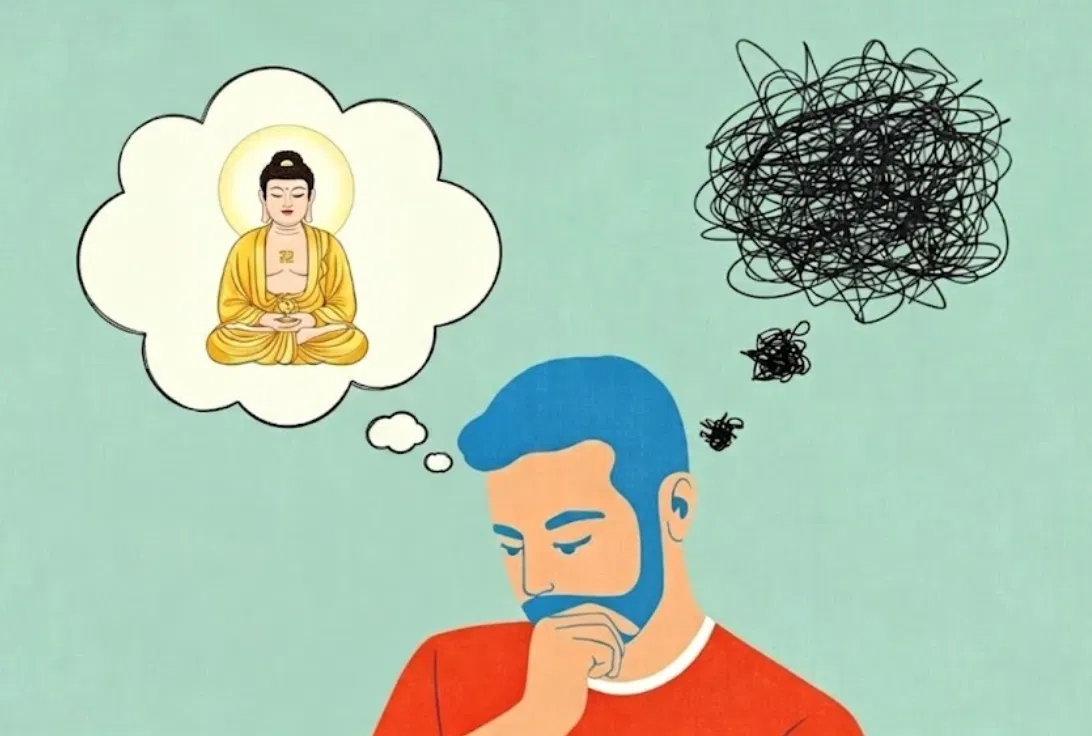
True Nianfo—often translated as “mindfulness of the Buddha”—is not mere mechanical chanting; it is keeping the Buddha in your heart and aligning your consciousness with His. At its core, “mindfulness” (Nian) is defined by whatever occupies your mind at any given moment.
Most people spend their lives preoccupied with sensory pleasures; in doing so, they are effectively practicing “mindfulness of indulgence.” Once a thought takes root in the mind, action inevitably follows to pursue and possess it.
If you truly comprehend the boundless virtues of the Buddha, and realize that you inherently possess the exact same Buddha-nature, you will naturally and sincerely align your mind with the Buddha to reclaim those virtues. To remain indifferent to this inherent wealth is simply foolish. Those still asleep to this truth must rely on the patient guidance of spiritual mentors and friends to awaken.
During the Buddha’s era, even after achieving Arhatship and freeing themselves from the cycle of birth and death, many Arhats continued to follow the Buddha closely. Why? Because although they had reached their personal goals, they had not yet entered the Mahayana path. They still needed to learn how to ignite their aspiration for Bodhicitta and progress through the higher stages of the Bodhisattva path to ultimate Buddhahood.
If they had settled for their initial achievement, they would have stopped growing. It is like a student who graduates with top marks and chooses comfort over further mastery; such complacency makes it impossible to achieve full Buddhahood.
2. The Inherent Treasure and the Illusion of Subjective Reality
As the Avatamsaka Sutra (Chapter 51) beautifully states:
“At that time, the Tathagata, with his unobstructed and pure eye of wisdom, surveyed all living beings throughout the Dharma Realm and declared: ‘How strange! How strange! How is it that these living beings possess the complete wisdom of the Tathagata, yet in their ignorance and delusion, they neither see nor recognize it? I shall teach them the Sacred Path to free them forever from delusive thoughts and attachments, enabling them to discover within their own bodies the vast wisdom of the Tathagata, no different from that of the Buddha himself.'”
Previously, we did not know we possessed this supreme treasure. Now, pointed out by the Buddha, we do. Yet, due to deep-seated habits, we still cling tightly to our illusions and attachments. The core challenge is learning how to let go—releasing our firm grip on things that never truly existed.
Everything we consider “real” is merely a subjective definition we assign. Take food as an example: stinky tofu or blue cheese may be a delicacy to one person and completely nauseating to another. The objects themselves are neutral; they do not possess intrinsic qualities of “good,” “bad,” “right,” or “wrong.” Humans project these definitions onto them.
These definitions are highly unstable and can easily change over time through environmental influence and social conditioning. Yet, as a preference hardens into a habit, we begin to rigidly believe it is objectively real and grasp onto it. This tight grip is what we call “attachment,” and the constant mental chatter surrounding it is what we call “delusive thoughts” or “delusion.”
If we can release these delusions, step out of the mental chatter, and focus entirely on Nianfo—keeping the luminous nature of the Buddha in mind—we will undoubtedly uncover our true nature.
Truly understanding and practicing this level of mindfulness unleashes your inherent, dormant capacities. Realizing even a single innate power will bring limitless benefit, rendering all external pursuits obsolete because you recognize them as traps rather than true freedom.
For instance, the Divine Eye is not a supernatural trick, but a manifestation of your innate wisdom. It sees through all physical barriers—light, dark, distance, and solid matter—to perceive reality exactly as it is.
3. Understanding Cause and Effect
Buddhas utilize these innate capabilities to master the laws of cause and effect. Ordinary practitioners cannot discern these subtle laws without deep, patient investigation, even if they could see things directly. By tracing a single cause across infinite dimensions of time, space, and conditions, one comes to master the laws of Karma. This mastery must be built on the foundation of seeing reality as it truly is.
While non-Buddhist ascetics often possessed impressive supernatural powers, they lacked the analytical wisdom, patience, and exceptional rigor of the Buddha to fully comprehend Karma. Because they could not trace causes far enough, they lacked ultimate realization.
Consider the great disciples Shariputra and Maudgalyayana. Maudgalyayana was born with extraordinary supernatural abilities as a “default setting.” Yet, they remained unliberated until they met a disciple of the Buddha who recited a simple verse:
“All things arise from causes, and all things cease through causes; this is what my teacher, the great shramana, constantly declares.”
Because they possessed powerful, refined minds, they immediately applied their analytical capabilities to trace this principle to its absolute root, uncovering the ultimate law of Karma. Recognizing the Buddha as the ultimate sage who penetrates to the very essence of reality, they immediately became his disciples to complete their realization.
4. The “Bear Harvesting Corn” Metaphor for Modern Distraction
Every ordinary being naturally possesses these exact same capacities—the ability to see, hear, and comprehend all things without obstruction through the Six Wisdom-Powers. Among these, the most remarkable is the Power of Divine Transformation, which allows one to manifest or dissolve anything at will.
Why are we completely unaware of this magnificent treasury within us? Simply because we are “too busy.” We are frantically busy generating delusive thoughts and clinging to external phantoms.
We act exactly like a bear harvesting corn in a field: it grabs one ear of corn, tucks it under its arm, reaches for another, drops the first, and repeats this cycle endlessly, only to walk out of the field empty-handed.

We live our lives in this constant state of chasing and dropping. Reflect deeply on your own life: Where is the food you ate years ago? Where are the fine clothes you used to wear? Where are the physical bodies you cared for so desperately across your past lives? Nothing remains.
At the ultimate level, even this physical body is merely a dense, “solidified delusion” (solidified delusive thought). While regular thoughts exist in a wave-like or uncombined particle state, the physical body represents information condensed into matter—what the Shurangama Sutra refers to as a “solidified delusion.”
The Five Aggregates (Form, Sensation, Perception, Formation, and Consciousness) are all manifestations of delusive thoughts. Upon attaining Buddhahood, one clearly sees them as such. Until these mental obstructions are broken, we can only hold this truth as a theoretical concept.
From the enlightened perspective of a Buddha, the universe consists entirely of information. It is the information generated by your own delusive thoughts, your actions, and the imagery they project. The DNA of animals and plants, or even the molecular structure of mountains and rivers, are all expressions of information. Modern science has begun to approach this truth through quantum physics and the holographic universe theory, but it has yet to reach the ultimate source. The Buddha, however, thoroughly mastered and operated within this source with complete freedom.
5. Breaking the Loop: A Decisive Separation
Your inherent wisdom is a vast, self-sustaining gold mine. Yet, instead of tapping into this ultimate treasure house, we spend our lives chasing illusions, driven by unsatisfied desires, frustration, and helplessness—repeating this tragic cycle lifetime after lifetime.
A truly wise person, upon realizing this, stops playing the fool. The choice is clear: make a decisive break.
When a delusive thought arises, cut ties with it. Ask yourself: “I have entangled myself with these thoughts for lifetimes, and they have brought me nothing but pain. Why should I continue this relationship? Since I already know that my true abode possesses infinite wealth, peace, and freedom, I choose to align with awakening.”
In truth, even “delusion” and “attachment” do not exist objectively. They are merely arbitrary definitions we created or absorbed from others. Concepts like “good,” “bad,” “right,” or “wrong” carry no intrinsic reality; they change constantly.
For instance, people marry because they define their partner as “good,” only to find later that their expectations are unmet, leading them to define the person as “bad.” We label people as “good” when they align with our preferences and “bad” when they oppose them. This is utter confusion—building non-existence upon non-existence.
We desperately try to hold onto things that cannot be held. If physical things were truly solid and permanent, we would not age or die. Even subatomic particles cannot be grasped as hard, solid matter. Attempting to hold onto the ungraspable generates endless unwholesome karma, locking us in a continuous, closed loop.
To step out of this cycle, you simply need to “raise your foot” and step into a higher dimension. Because you drew the circle of suffering yourself, you can break it simply by choosing not to draw it anymore.
6. Moment-to-Moment Awakening
As the Sixth Patriarch Huineng famously declared:
“Originally there is not a single thing; where can dust alight?”
Within this fundamental emptiness, we create phantom gains and losses. In truth, at the ultimate level, there is nothing to gain and nothing to lose.
True Nianfo is this moment-to-moment awakening. It is the continuous realization of your inherent nature, recognizing that the Buddhas have fully cultivated this capacity to perfection while we have allowed delusive thoughts to obscure our clarity.
When the Fifth Patriarch Hongren rescued the Sixth Patriarch Huineng after he fell into the quicksand while fleeing from Xiong Fei, he gave him this timeless advice:
“Do not dwell on the past; what is gone is no longer there.”
Ruminating on past grievances—”Why did they hurt me? Why did they treat me this way?”—is completely useless because the past cannot be held. Instead:
“Always look toward what lies ahead; let every thought be clear and luminous, and see your original nature.”
By shifting your focus away from these illusory concepts of right and wrong, the connection between your senses and external distractions will naturally dissolve. In time, your inherent Buddha-nature will reveal itself, and you can begin to apply its natural, unobstructed capacities to benefit others.
For a Bodhisattva, these supernormal capacities are like wings to a bird—essential tools for liberating countless beings. Deep-seated habits may cause some inertia when you first try to stop, much like a moving car cannot brake instantly. Do not be discouraged. Simply apply the brakes gradually, and the momentum of delusion will eventually come to a complete stop.